Monday, March 21, 2011

Stoichiometry Expanded

We first turned in our solubility labs from Friday. When then began our discussion, extending off the solubility problems. (Also we have a test on friday) Everything was mostly a review from stoichiometry 1st semester except for molarity and molality.

When then preceded to solve this problem for practice:

How much calcium carbonate will be precipitated by adding 25.0 ml of calcium chloride to 25.0ml of 56 M potassium?


I left out the ml to l conversation factor and the 1 to 1 mole conversation for the second equation above.

We also did the first problem of the worksheet.


Remember to keep doing those web assigns and worksheets for preparation for the test on friday!
The next scribe will be Ben T !

Saturday, March 19, 2011

Molarity vs Molality vs Molasses

On Friday we talked about the idea of molarity and molality. Molarity (M) is = to the moles of solute/liters of solution. Molality is not as common, as shown by the fact it is not in some dictionary. Molality is = to the mol solute / kilograms of solvent.
We then continued to solve some example problems of calculating concentrations. Take a look at your notes for some extra practice.
Molarity and Dilution
At the end we introduced the concept of Molarity and dilution, and established this formula
m1v1 = m2v2.

Here is a video walking through the conversation of Molality to Molarity.


Here doesn't sound very happy, but he is pretty concise. Also remember to do your webassigns and homework. Also molasses has no link to chemistry if you were curious,but they did come to mind.

Thursday, March 17, 2011

Heat, Cool and Repeat

Today we started off class by turning in our Solution Formation lab. (Mr. Lieberman also wants to know where his door stopper is...if anyone knows or finds it)

The rest of class was working on our new Solubility Curve lab (due Monday).
This took up the whole classtime and we even had to split up the work amongst our groups to get the job done faster. Essentially, we had two "series" to run, each with the same procedures but with different masses for the materials in the three test tubes.

In the first session, test tube A had to contain 0.45 to 0.50 grams of potassium nitrate (KNO3), test tube B had 0.70 to 0.80 grams, and C had to have 1.20 to 1.30 grams.
I massed each of these tubes and then with the KNO3. Then I massed each test tube with water added. From there, I placed each test tube into boiling water and stirred them gently (well actually, prodded at them more) to make the KNO3 dissolve faster. Once it was completely dissolved, I first took out test tube C and placed it in a beaker of iced water to make it crystallize. The temperature at which test tube C started turning white was recorded. This is the same as the saturation temperature. What was done to test tube C was then done for the other test tubes.

The second series (that was being tested at the same time) had test tube A massed at 0.35 to 0.40 grams, B with 0.90 to 1.00 grams and C with 1.50 to 1.60 grams. My partners then repeated the process I explained above.


<------(crystallized KNO3)


There are some calculations and a graph to do on the computer to go with this lab, along with the conclusion.
(There is also a Webassign due at 1:00 Friday.. just in case)
The next scribe will be.....Austin W.

Wednesday, March 16, 2011

Factors Affecting Solubility

I'm filling in for Michelle T.

Today was a notes day. We explored how certain conditions, specifically temperature and pressure, impacted the solubility of solutions. Each of these conditions affects their solute differently based on its state of matter; a solid, gas, or liquid.

An increase in temperature for solids and liquids results in an increase of solubility, as the intensified intermolecular motion allows for a more thorough interaction between the solute and solvent. However, higher temperatures in gases results in molecules being released to the atmosphere instead of contained within the solvent, resulting in lower solubility.
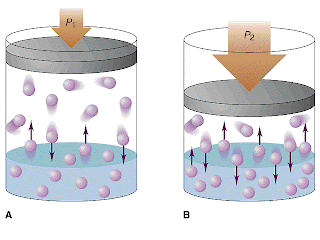
Pressure only changes the solubility of gases. Solids and liquids already have their molecules tightly packed so that an increase in pressure would not change the structure of the solute enough to change solubility. Gases are more prone to be altered by pressure because their molecules are more spread out. The increase in pressure forces the molecules of gas down into the solvent, increasing solubility.

We discussed real world examples describing the relationship between pressure and solubility. Soda is kept under high pressure in its can. When that pressure is released when the can is opened, pressure no longer forces the CO2 molecules in to the soda. The CO2 rises to the top in the form of bubbles and thus, carbonation.

Here's some scientific photos to help explain:

BEFORE:


AFTER:


It seems as though a rapid decrease in solubility also has the side-effect of a spontaneous age, gender, and race change.

I guess the next scribe is Michelle T., to fill her duties from today.

Tuesday, March 15, 2011

Solution Formation Lab

Today was late arrival and we had shortened periods, which means we spent the whole period working with our lab groups on the solution formation lab. The goal of the lab was to determine the effect of crystal size, temperature, and degree of mixing on the solution formation. Each group had to develop their own procedures to test the three variables for a solution of copper sulfate disolved in water.


For our groups procedures, we kept all of the variables the same except for the one we were testing, in order to make sure the that change in results is because of the change on the variable that we controlled. For example, the first part of the lab was to determine how the size of the crystal effected the solution formation. By testing three different sized crystals of copper sulfate at the same temperature, our group got the conclusion that the larger the crystal, the longer it takes for it to dissolve.


The second part of the lab was to test the effect of the temperature of the solvent on the formation. Our group used water at three different temperatures and the same amount of copper sulfate, and by dissolving copper sulfate in all of them, we discovered that if the temperature is higher, the crystals will dissolve faster.


The last part of the lab was to test the effect of the degree of mixing on the formation the of the solution. To test this, our group mixed the solution with a stirring rod at different speeds but the same amount of copper sulfate and at the same water temperature. By keeping time, our group found that the faster you stir, the faster the crystals will dissolve.


So, that is pretty much it for our shortened class.
The conclusion part of the lab is for homework and it is due on Thursday.
The next scribe will be Michelle T.