Showing posts with label Classifying Chemical Reactions. Show all posts

Tuesday, November 9, 2010

Insolubility and Solubility

Mr. Liberman started off class today by first reviewing the rules of solubility and insolubility. First off, we restated what those words mean: something is soluble if it is able to dissolve in water, and something is insoluble if a precipitate forms in water. Then Mr. Lieberman explained that the lab that we did yesterday was the basis on which we were eventually going to base the solubility of certain compounds off of. This will include compounds that are commonly found around us and whether they are soluble or not, but it is not that black and white. There are some compounds such as silicate (SiO3) that is insoluble unless it contains the ions of K+ and Na+. There are many more examples like this.

To make things more interesting, Mr. Lieberman did the Lead Iodide experiment to show that certain compounds are always soluble (NO3), and therefore, you are able to identify the solids in a reaction. See Video Below:

This reaction is of Lead and Iodine. This solid had to form between these two elements because NO3(nitrate) mixed with any other element is soluble.


Since Lieberman was in a good mood, after explaining all of this, he let us work on the lab and the worksheets we got. Everybody was working until the bell rang and class ended. That was it for the day. The next scribe is....

Kaitlin S.

Thursday, November 4, 2010

The Scream Heard 'Round the World

Today, class started off with Mr. Lieberman telling everyone to get out their Classifying Chemical Reactions Lab so we could go over the post-lab questions, which asked you to find the equations for some experiments that you did during the lab. People wrote the answers on the board and we cleared up any questions about them. For answers see Brandon L's previous post that described the lab's experiments and their equations.

After we finished discussing the lab, we moved on to the notes for the day. Although we only got through the first part of the notes, we still learned a lot about solutions, and how electrolytes and ions are related. Mr. Lieberman explained that a solution contains a solute, which dissolves, and a solvent, which is what the solute dissolves into. He also explained how water was the most common solvent. As a solvent, water dissociates ionic compounds into its ions. For example if you dissolved table salt (NaCl) into water, then one would see each individual ion separately, because water breaks the Na+ and Cl- apart.

We started to talk about electrolytes, and the difference between strong and weak electrolytes. I general, electrolytes are allowed to pass through a current if there is a sufficient amount of ionization. Strong electrolytes contain enough ions to carry a current efficiently, while weak electrolytes don't completely dissociate and have a small amount of ionization.

To give us a visual of how electrolytes and ions really worked, Mr. Lieberman performed the light bulb experiment. First he used sugar to see if he could light the light bulb. To fake out the class he screamed to make it seem like there was going to be light. Sure enough, the infamous Korri then proceeded to shriek so loudly, that it was heard around the country, and maybe even the entire world because it was as if every students ear drums were being punctured and then completely ruptured. Mr. Lieberman then demonstrated how the sugar, which has no ions, didn't light the light bulb. He then mixed salt and water together. The water acted as the solvent and the salt was the solute. Na+ and Cl- ions were formed and the light bulb irradiated a lot of light.

You can check out this video, as a woman explains electrolytes and currents.
That's it for class on November 4th.
The next scribe will be the oh so special, John A.

Wednesday, November 3, 2010

Can You Classify Chemical Reactions because I hope I can


Today and yesterday in Lieb's class we started off by talking about the 3 worksheets we need print off of moodle after this we began our class notes on the 5 types of reactions: Synthesis, Decomposition, Single Replacement, Double Replacement, and Combustion Reactions.
A synthesis Reaction is when you are given two reactants that combine to give you one product for example: 2H2 + 02 -----------> 2H20
A Decomposition Reaction happens when compunds are broken into elements or similar compounds. Example: 2H20 ---------> 2H2 + 02
A Single Replacement Reaction is when an element replaces another compound. These only take place in wate. Example: NaCl + F2 ---------> NaF + Cl2
A Double Replacement Reaction happens when one metal replaces another in a compound and the same for the non-metals. Example: AgN03 + NaCl ----->AgCl + NaN03
A Combustion reacion only occurs when a hydrocarbon reacts with oxygen gas. Example: C5H12 + 802 ------>5CO2 + 6H20
Now on to the Classifying Chemical Reactions Lab YES!!!!!!!!!!!
So, to begin with we went over the Pre-Lab in Question 1 we had to summarize the chemical reaction of sodium bicarbonate, carbon dioxide, and water. This turned into
2NaHC03-----> C02 + H20 + Na2C03. When balanced.
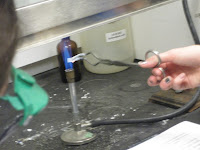
We then had two days to go through the 7 different stations and do all the experiments. In reaction 1 We Burned Magnesium ribbon. The Magnesium ribbon lit on fire and got chalk white after it burned. The chemical Reaction that occured was 2Mg + 02 ----> 2Mg0.
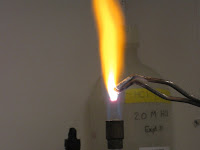
In the first picture we see the product of the Magnesium ribbon turning pure white and in the second it is lighting on fire.
In reaction 2 we put hydrochloric acid in a test tube with Magnesium Metal, and then we lit a wood splint and put it in the tube where it was extinguished. These turned into
2HCl+ Mg ----> MgCl2 + H2
The answer above has been balanced. In this picture we see the hydrochloric acid and Magnesium Metal Ribbon mixing and bubbles occuring.
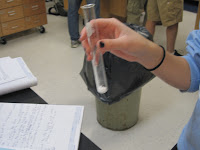
In reaction 3 we put ammonium carbonate in the test tube an burned for 30 seconds then we put a piece of litmus paper at the top and an odor was released. This odor was amonia next we put a piece of wood flint on fire into the tube which was extinguished. The reaction for this was (NH4)2C03---> C02 + NH3 + H20 when balanced.
In this picture we see the mixture of amonia being released.
In reaction 4 we put calcium carbonate in a test tube with hydrochloric acid and once again lit a wood splint which was extinguished.
This reaction when balance became 2CaC03+ 2HCl-----> 3C02 + 2CaCl + H20.
In the second picture we see the wood splint being extinguished.
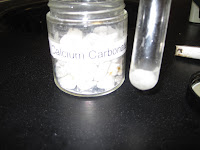
In the first picture we see the Calcium Carbonate and hydrochloric acid mixed.
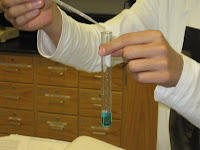
In reaction 5 we mixed copper (II) Chloride and mossy zinc together and the mozzy zinc change color from silver to read. CuCl2 + Zn-------> ZnCl2 + Cu. When balanced.
In this picture we see the zinc changing color.
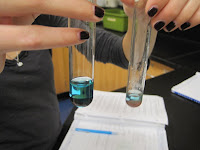
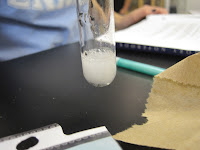
In reaction 6 we added copper chloride with sodium phosphate and a precipitate formed. When this reaction was balanced it became
3CuCl2 + 2Na3P04------> Cu3(PO4)2 + 6NaCl
In this photo you can see the precipitate forming.


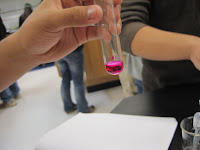
In reaction 7 we mixed sodium hydroxide and phenolphthalein and the hydrochloric acid. During this reaction it at first became pink and then back to clear liquid color whise. In this reaction when balanced it became NaOH + HCl-----> H20 + NaCl As you can see in the pictures below it demonstrates the pink on the right and then clear again on the left

Well that was our class in a nut-shell and the coveted spot of scribing for Thursday goes to my man Josh D CONGRATS!!!