Today, we did more practice in stoiceometry with limiting factors. We had the equation "Al + CuCl(2) --> AlCl(3) + Cu". First we had to balance the equation, so we got "2Al + 3CuCl(2) --> 2AlCl(3) + 3Cu". Now that we had the mole ratio, we could figure out which is our limiting reactant with the information of .82g Al and .87g CuCl(2).
To find out which one is the limiting reactant, there are two ways.
The first way, you could find out how much of one reactant you need to react with the other. We used Al for this one. So we take the mass, .82g Al, multiply it by 1 mole over it's molar mass, then find the mole ratio of Al and CuCl(2) (which is 2 to 3), then multiply it by the molar mass of CuCl(2). Since the answer (6.1g CuCl(2) was more than what we have (.87g CuCl(2)), we can conclude that CuCl(2) is our limiting reactant. If out answer turned out to be less than .87g, Al would be our limiting reactant.
The other method is to find out how much of each reactant you need to produce one product. It's always good to look ahead since this question 99.2% of the time will be right after the first: how much of a product you could make. You would follow all of the above steps for each of the reactants and you would choose a product. We used Cu as our finishing product. Remember, whichever reactant produces the least of a product is the limiting reactant. In the end, CuCl(2) produced the least Cu, which turned out to be .41g. Since that's the most that CuCl(2) can produce, that is all that will be produced. You don't do anything with that number!
So after we react this all, how much Al is left? well... to find that there are two ways you could do it, but both are pretty much the same.
First you could take how much of the limiting reactant you have and find out how much of the excess reactant you need to react it, which then you subtract that from how much you start with. To get this, just follow the steps listed in paragraph 2, except for the limiting reactant.
The other way is to take that .41g Cu and see how much of that excess reactant (Al) you need to react with that. It's basically all the same as listed above with different variables.
After we got through all of that, we got to our worksheet, Limiting Reactants, which is part of our homework.
For tomorrow, We need to have our Lab which we recently did and our chemistry question set #1.
1 silver troy ounce = $27.46, I got part of your homework done.
If you're still reading, please come up to me tomorrow and give me a waffle.
We will most likely have a quiz tomorrow, we were lucky not to have one today.
The next scribe will be... Austin W.
Showing posts with label Stoichiometry. Show all posts
Showing posts with label Stoichiometry. Show all posts
Monday, November 22, 2010

Tuesday, November 16, 2010
Pop Goes the Weasel!
Except sometimes it happens to be a mole. We started off class today with some stoichiometry notes and another one of Mr. Lieberman's crazy experiments. The goal of this one was to make a mole fly out of a tube that Mr. L constructed himself. We were all scared. We took CaC2 + 2H2O -> Ca(OH)2 + C2H2 and created a combustion reaction:
2C2H2 + 5O2-> 4CO2 + 2H2O
From this Mr. L asked us how many grams of H2O will form if .60 grams of CAC2 reacts. This is the formula we got:
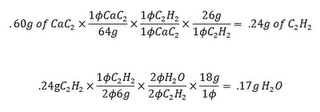
We ended up with .17 grams of water. Now it was time to put this formula to the test. Mr. Lieberman loaded up his mole-rocket with the special ingredients from the formula. It was the combination of the CaC2 and H2O that created the Acetylene gas. This gas was the ignition that the rocket needed to make the mole fly. Suddenly there was a BOOM! A little red object shot across the room followed closely by a trail of fire. There were a few screams, particularly from Korri, which was expected. The room then filled with a smell that was immediately placeable: It was a mix of burnt hair and/or that smell from straightening your hair when it is still slightly damp.
Next, we all took our 4 question quiz. It was then graded and handed back. Hope everyone did well! And the next scribe issssss........Mollie M!
2C2H2 + 5O2-> 4CO2 + 2H2O
From this Mr. L asked us how many grams of H2O will form if .60 grams of CAC2 reacts. This is the formula we got:
We ended up with .17 grams of water. Now it was time to put this formula to the test. Mr. Lieberman loaded up his mole-rocket with the special ingredients from the formula. It was the combination of the CaC2 and H2O that created the Acetylene gas. This gas was the ignition that the rocket needed to make the mole fly. Suddenly there was a BOOM! A little red object shot across the room followed closely by a trail of fire. There were a few screams, particularly from Korri, which was expected. The room then filled with a smell that was immediately placeable: It was a mix of burnt hair and/or that smell from straightening your hair when it is still slightly damp.
Next, we all took our 4 question quiz. It was then graded and handed back. Hope everyone did well! And the next scribe issssss........Mollie M!
Subscribe to:
Posts (Atom)