Showing posts with label Emilio I. Show all posts

Tuesday, April 5, 2011

Colliding into Activation Energy

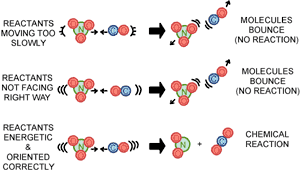
By: Emilio I. April 4th was the first day back from Spring Break so we began a new unit, unit 11: Kinetics and Equilibrium. We started off by talking about the collision theory and how a chemical reaction can not occur if the reactions do not collide. Mr. Lieberman used the example that if two substances are on opposite sides of a container, they cannot react at all! This is true because when molecules collide they transfer kinetic energy and break the bonds that hold other molecules together.
Kinetic energy is half the battle, the other half is having correct orientation. In order for a reaction to occur between molecules, specific atoms must crash into eachother at specific speeds. Here is an image describing the idea behind orientation and chemical reactions:
The Kinetic energy required to break the bonds in a molecule and cause a chemical reaction is known as the Activation Energy. It is also referred to as the Activated Complex. It is at the top of the graph showing a reaction's energy, just like this one: We only discussed one way to increase the speed of this type of reaction, although there are many ways to do this. The one we discussed is by adding a catalyst that lowers the activation energy which allows a higher number of reactions to occur among the molecules in the reaction. The catalyst is not a part of the reaction, though, so it will not appear in the reactants or products. The next Scribe will beeeeee: Kaitlin S. Goodluck

Monday, March 14, 2011

Let Chemistry Absorb You. Ha.

Alright, boys and girls, this here's a chemistry post and it's about to get real.

Mr. Lieberman reviewed the test with us, like a boss, and gave us two points because of an error and because of leniency. Then he reviewed with us the basic principles of solutions.
  • A solute is the substance that is being dissolved
  • A solvent is the liquid in which the solute is dissolved
  • Solute dissolves in solvent
  • Aqueous = solution with water as solvent
Easy, right?

A saturated solution is a solution where the solute has dissolved into it at a maximum. No more solute can be dissolved in this saturated state.

In the notes that Mr. Lieberman explained in class, there is a diagram of NaCl dissolving in H2O showing the driving forces that cause the dissolving of this solute, NaCl, into this solvent, H2O (most of the solvents in this unit will be H2O and all of them will be liquids! Awesome!). In the diagram, the H2O molecules, which are polar, attach themselves to the Na+ or Cl- atoms according to polarity. So an H2O molecule's negative pole will attach to the positive Na atom. And an H2O molecule's positive pole will attach to the negative Cl atom. This will pull the crystal-like structures of NaCl apart. This is a demonstration of an ionic solute dissolving by dissociation into its ions. There are two more types: Covalent solutes dissolving by H-bonding to water and covalent solutes dissolving by London dispersion forces (LDF).
This process is carried out instantaneously, it cannot be viewed through a microscope or observed at all, for that matter.

Furthermore, there are three stages to this same solution process explained in further detail here.
  1. Primarily, there is the separation of a solute, and in order of this to happen, the solute's molecules must surpass their intermolecular forces (IMF) and it requires energy, making it endothermic.
  2. Secondly, the separation of a solvent occurs when the solvent overcomes its intermolecular forces. This also requires energy, also making it endothermic.
  3. Thirdly, the interaction of these two substances occurs. An attractive bond forms between the solvent and solute molecules and this releases energy, making it exothermic.
Phenominal! Now we understand the heat exchanges that occur within this process, let's continue!

We continued with the in-class notes and took a look at the factors affecting the solubility.
We know that Like dissolves like, which means that molecules with the same type of intermolecular forces will dissolve in eachother. E.g. dipole-dipole, Hydrogen bonds, and LDF.
Cool, huh?
Tell you what's not cool, that the raise of temperature in these solutions causes more collisions which allows easier access into these crystal structures, allowing for further saturation of a solution.
Finally, there is pressure. Solids and liquids are hardly affected by pressure changes in relation to solutions, but gas, under higher pressure, will have a higher solubility.

Well done, Captain, you have successfully acquired knowledge of solutions and can continue on your path to success. Enjoy your good HEALTH:


The next scribe is Becky N. (Rebecca N.)

Tuesday, January 25, 2011

Hurts like Steam!


Today in chemistry class, Mr. Lieberman discussed with us how our tables should look like for the lab we did on January 24th, as shown by the image on the left.

The theoretical heat curve that can be observed has two platforms. The first platform is at the bottom left, which is the melting phase where the ice melts into a liquid. This platform only has temperatures from 0 degrees C to approximately 5 degrees C. After this melting phase, it is liquid, where it immediately gains energy and increases in temperature all the way to the boiling point. The boiling point is the second platform. Here, the water is boiled and vaporized into the air at the temperatures 100 degrees C to approximately 101 degrees C.

The amazing section of this lecture was that past beyond the vaporization
point, the temperature of the steam can keep increasing to an infinitely high number. This is equally true for the melting point, for before the ice melts, it can have an infinitely low temperature. Both of these situations is demonstrated by the picture below.


We also learned that during the melting phase \Delta H fusion = kJ/\o is the equation used to determine the heat in order to cause this physical change from solid to liquid. To f
ind the energy that is used to reach the boiling point, this equation must be utilized: q=M x C x \Delta T . And finally, to find the energy that is used to actually turn the water into vapor, this equation must be utilized: \delta H vaporization = KJ/ \o

Stepping aside from Chemistry for a moment, I give you a picture of a small monkey. Attempt to absorb his cute-ness and calculate the percent error of cute-ness absorbed versus the theoretical cute-ness that the monkey gives off.


Mr. Lieberman performed a demonstration where he had a coiled copper tube inside of a flask, which is has water and is on a hotplate. Once the water began to boil, the hot steam went into the copper tube. Under the coiled part of the copper tube, the steam trap, there was a burner that heated the steam substantially in order to prove that steam can be heated to a way higher temperature. This can be seen by the line graph farther above. The steam, however, was able to burn a hole through a sheet of paper and it was able to light a match!

The next scribe is Korri H.

Kickin'!

Wednesday, October 20, 2010

'MOLE'ten Lava


Honors chemistry period six is now on round two for these scribe posts because we had to skip Elim.

Mr. Lieberman began the class by letting us correct and ask questions about the worksheet "Mole Problems 2." The worksheet was more practice, that we all needed, on converting particles, moles, and mass. For those that missed it, 6f should be scratched out.

We also corrected and asked questions about the second converting sheet, the one with no name.
Like Kaitlyn stated in her post, the conversions are:

  • For grams to moles, divide by molar mass
  • For moles to grams, multiply by molar mass
  • For particles to moles, divide by Avagadro's number
  • For moles to particles, multiply by Avagadro's number


    We, then, moved on to the lab, "% Composition of Bubble Gum," which we did not do a pre-lab for. Mr. Lieberman told us to fit all of the lab on one page, because it is a relatively short one. The procedure was as follows:
    1. Take the gum and mass it with the wrapper (record)
    2. Unwrap and chew gum
    3. During the chewing process, mass the wrapper (record)
    4. Place chewed gum on wrapper and mass it (record)
    Amazingly, the mass of the gum dropped drastically, but that's because the sugar in the gum was consumed by the chewer of the gum. Our lab group's gum had a mass of 6.13 grams and the sugar within the gum had a mass of 3.97 grams. From here we had to answer 5 post-lab questions:
    1. Calculate the mass of sugar in the bubble.
    2. Calculate the % composition of the sugar (by mass of the bubble gum).
    3. Calculate the moles of the sugar and gum using the molar masses given the procedure.
    4. Using your answer from question number 3, determine a possible empirical formula for the bubble gum.
    5. Researchers have found that the ideal formula for the gum is GS2, where G is a fictional elemental symbol for gum and S for sugar. How does your gum compare to the ideal? What might be some sources of error?
    An empirical formula can be made by the following procedure from http://chemistry.about.com/od/workedchemistryproblems/a/empirical.htm
    1. Assume you have 100 g of the substance (makes the math easier because everything is a straight percent).
    2. Consider the amounts you are given as being in units of grams.
    3. Convert the grams to moles for each element.
    4. Find the smallest whole number ratio of moles for each element.
    There is a mole quiz tomorrow, and this lab is due friday. Don't fall behind on all this work, it is alot to do. Also, there is a "mole day" party on saturday at 6:02 AM, but Mr. Lieberman did not give us alot of information on it.

    -Emilio I
    The scribe for tomorrow's class is: Zoe S.

    Tuesday, August 31, 2010

    Finishing up the Lab


    The class today was in a fairly good mood when Mr. Lieberman started us off by congratulating Kathryn on her wonderful scribe post and notified me about mine. We continued to talk about the blog and functions such as the photo issue that is now resolved, and immediately after, went to finish the "Observation Lab."


    We were told to complete part B of the experiment by creating our own experiments to discover what reagents, when mixed together, caused certain reactions. Of course, we were told to record all observations in our handy "Scientific Lab Notebooks." My lab group, and most other lab groups, executed a total of five experiments and for some, more than that. It was fairly easy work, and the results were astonishing. For example, when the four reagents, sodium bicarbonate, calsium chloride, water, and phenol red, were combined in the plastic bag, we came up with an opaque, yellow, fizzy liquid (shown in the picture). Very interesting stuff. Aside from the two glass beakers shattering on the floor, all went well.
    The class, at their own desks, took up netbooks and registered themselves to ChemThink, in order to complete the assignment Mr. Lieberman assigned.
    Homework: ChemThink and worksheet "Particulate Nature of Matter," and the eight Post Lab Questions.
    Pretty easy day, it was very relaxed and enjoyable. Who knew Mr. Lieberman was into Weezer?
    The next Student Scribe is Brandon L.