Showing posts with label Colleen C.. Show all posts

Tuesday, November 16, 2010

Pop Goes the Weasel!

Except sometimes it happens to be a mole. We started off class today with some stoichiometry notes and another one of Mr. Lieberman's crazy experiments. The goal of this one was to make a mole fly out of a tube that Mr. L constructed himself. We were all scared. We took CaC2 + 2H2O -> Ca(OH)2 + C2H2 and created a combustion reaction:
2C2H2 + 5O2-> 4CO2 + 2H2O
From this Mr. L asked us how many grams of H2O will form if .60 grams of CAC2 reacts. This is the formula we got:
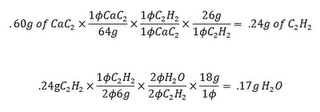
We ended up with .17 grams of water. Now it was time to put this formula to the test. Mr. Lieberman loaded up his mole-rocket with the special ingredients from the formula. It was the combination of the CaC2 and H2O that created the Acetylene gas. This gas was the ignition that the rocket needed to make the mole fly. Suddenly there was a BOOM! A little red object shot across the room followed closely by a trail of fire. There were a few screams, particularly from Korri, which was expected. The room then filled with a smell that was immediately placeable: It was a mix of burnt hair and/or that smell from straightening your hair when it is still slightly damp.

Next, we all took our 4 question quiz. It was then graded and handed back. Hope everyone did well! And the next scribe issssss........Mollie M!

Monday, October 4, 2010

Classifying Elements

Hey everyone! Today in class we worked on the Metal, Nonmetal, Metalloid Lab. In this lab, we worked to classify eight elements, based on their physical and chemical properties, as metals, nonmetals, or metalloids. These eight elements included: Aluminum, Carbon, Iron, Magnesium, Silicon, Sulfur, Tin, and Zinc. We classified them based on the physical properties of appearance, luster, malleability/brittleness, and electrical conductivity. We also tested the chemical properties using hdrochloric acid and a copper chloride solution in test tubes. Everyone had to be careful with the Copper Chloride because it is corrosive to the skin and eyes.metals nonmetals metalloids lab 011 metals nonmetals metalloids lab 010 metals nonmetals metalloids lab 009 metals nonmetals metalloids lab 008 metals nonmetals metalloids lab 007 metals nonmetals metalloids lab 006 metals nonmetals metalloids lab 005 metals nonmetals metalloids lab 004 metals nonmetals metalloids lab 003 metals nonmetals metalloids lab 002
For physical properties, we looked at the appearance of the different elements. Al was spherical and silver. C was Black and powdery. Fe was strong and silver. Mg had ridges and was silver. Si was powdery, silver and strong. S was yellow and powdery. Sn was clumpy and silver. Zn was flat, grey, and smooth. For luster, Al, Fe, Mg, Si, and Sn are all shiny. C, S, and Zn were all dull. C, Si, and S were brittle.
metals nonmetals metalloids lab 017 The rest were malleable. Al, Fe, Mg, and Sn were conductive to electricity. C and Mg reacted with the HCl by creating bubbles. Al, C, Mg, Sn, and Zn all reacted with the Copper Chloride by having a corrosive effect on the element and by creating bubbles. They were claasified, using this information, for metals if they had luster, malleability, and conductive to elecricity. Many metals also react with acids and Copper Chloride solution. Nonmetals are dull, brittle, and do not conduct electricity. Most nonmetals do not react with acids and Copper Chloride solution. Elements that have at least two properties of both are considered metalloids. The rest is in the post-lab! Oh, and thank you John for helping me with the pictures. The next scribe is........Kaitlin S.!