Wednesday, December 8, 2010

What it really Boyles down to

Today we started by quickly reviewing Dalton's Law and Boyle's Law, with a couple more gas chamber experiments. he sucked all of the air out of the container (after realizing he needed to attache the hose) and made shaving cream get big, unfortunately he stopped it before it made a mess. He also did an old marshmallow which was rather uneventful.

Then we went on to discuss conversion between temperatures of celcius and kelvin because it is necessary to know for formulas. The reason you need to know the Kelvin temperature is because if you use celcius you may end up with correct calculations stating that you ave negative density, which i hope all of you know is "impossible" according to Mr. Lieberman. To convert celcius to Kelvin all you need to do is add 273 degrees to the celcius measurement.

Then as we continued our notes we went on to Charles' law, which states: The volume of each gas is directly proportional to temperature. V=bT where b is a constant and V1/T1=V2/T2. This means that the original volume over temperature will be equal to the new volume over temperature. To explain this to us he showed us a quick experiment by heating to small flasks with water until they boiled, he then stuck a balloon on top of one which was still boiling and the balloon filled as the gas expanded. he stuck another balloon on top of the other right after removing it fro the heater, the balloon was quickly sucked into the flask because of the rapid change in temperature and the fast reduction of volume.
gas law demos part2 003

Next D Liebs quickly explained Avogadro's law which states: Volume is directly proportional to the number of moles of gas. To show this he simply blew up a balloon and let go, letting it soar around and land on Alex's desk. This demonstrates that as moles of air are released there is less and less volume and pressure to keep the balloon inflated, so it eventually collapses. then there is the infamous combined gas law which is P1V1/T1=P2V2/T2 this can be used to apply all forces to one equation instead of several different ones.

There was also a sheet to pick up at the front when we walked in, that sheet is homework and is due come test day. Speaking of which is next friday, the friday right before break. Also, everyone check out the little map thing to the right, people all over the world have seen our blog!

Also since Ben never posted any hilarious pics that im sure everyone wants, here is zoë, looking as happy as a person being vacuum sealed.

gas law demos 014


And now the next scribe will be... OH MY GOODNESS... Deena M.

Tuesday, December 7, 2010

The pressure is on

Today in class, we learned about pressure and saw a few demos. We saw Mr. Lieberman lay down on a bed of nails, and then a few of us got to try as well. The reason people didn't get stabbed to death by the nails is that pressure equals force divided by area (P=F/A). He explained that no matter how big or small an object is, the force remains the same. The dependent part is the area. The bigger the object on the nail bed, the less pressure is on them due to the increase in area.
http://www.flickr.com/photos/hc1011/5241587429/

We also learned the different units for measuring pressure, and the conversions between them. They are: pounds per square inch (psi), atmosphere (atm), Torr, or millimeters of mercury (mmHg), and pascal (Pa). The conversions are: 14.7 psi=1 atm=760 mmHg=100 kPa. We also went over how barometers and manometers work, with the atmosphere pushing down to show the pressure.

We went over Dalton's law too, which states that the sum of partial pressures of gases equals the total pressure of the gases when combined. So, if gas 1 is 1 atm and gas 2 is 2 atm, when they are combined the pressure is 3 atm. Boyle's law deals with pressure and volume, stating that the product of the pressure and volume for a gas equals a constant, k (PV=k). So no matter what differences in pressure or volume occur, P1V1=P2V2.

We also got to see Brandon and Zoe get stuffed in a trash bag and have the air sucked out to demonstrate the actual air pressure here on earth, as well as see an inflated balloon expand when the air is sucked out. Happy late arrival tomorrow, and the next scribe is Peter W.
http://www.flickr.com/photos/hc1011/5241588237/
http://www.flickr.com/photos/hc1011/5241588451/

ChemThink gases

Yesterday in chemistry, we went over our new unit, which will end on Friday the 17th with the unit test. After that, we went on the computers to do a ChemThink on the properties of gases. We learned that gas atoms can be affected by temperature as well as size, which changes their speed. We also learned that the pressure of a gas equals its force divided by area. Pressure is caused by gas atoms' impact on the sides of their container. Pressure goes up as the temperature rises due to the fact that there are more collisions, and that they're more forceful. Also, as the number of atoms rises, the pressure rises because there are more collisions. As the volume of the container increases, the pressure goes down because there are less collisions. So overall, we looked at four properties of gases: temperature, pressure, number of atoms, and volume.

Tuesday, November 30, 2010

Percent Yield

Today, we synthesized all of the concepts we've learned about Stoichiometry into the idea of percent yield. Percent yields are used to compare the amount obtained to the potential that could have been obtained. We learned about the real world usage of percent yields in fields such as the drug industry. It was amazing the impact such a seemingly minute improvement could have on productivity.

The way to determine percent yield is to divide the actual yield by the theoretical yield. First, you have to find what each of those are. Actual yield can only be obtained through experimentation and producing a measurable reaction. Theoretical yield is found through the same stoichiometric formulas we've used before to convert mass of a reactant to mass of a product.

Mr. Lieberman did a demonstration for the class to find the percent yield for. Sucrose was dehydrated using Sulfuric Acid to form Carbon (Graphite) and Water. After the reaction, we realized that the actual yield actually was larger than the theoretical yield. However, there were some flaws in our experiment as there could have still been excess water and acid. From this, we learned that the theoretical yield should typically be less than the actual yield.


Hope everyone had a great break, and there's only two and a half more weeks until the next one!
The next scribe is Ben T

Sunday, November 28, 2010

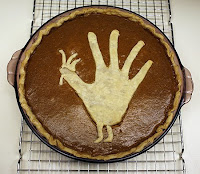
Pumpkin Pie Reactants


I hope everyone had a great thanksgiving!

On Tuesday we turned in our Copper and Silver Nitrate Labs, and our first set of problems in the "HomeFun Problem Set." Mr. Lieberman went over 2 of the homework problems, #67 and #68, before we turned the assignment in. We further reviewed over limiting reactants during class.
Soon after the review we took the Stoich Quiz #3 - Revenge of the Stoich. If you haven't noticed yet all the titles are related to Star Wars in some way.

Over the break make sure you do the Copper Cycle pre-lab.
If you need a copy of the lab here is the link: Copper Cycle

To help you get in the limiting reactants thanksgiving mood, here are the actually ingredients to make a pumpkin pie:
1/3 c. firmly packed brown sugar
1/2 c. sugar
1 tsp ground cinnamon
1 tsp ground ginger
1/4 tsp. ground cloves
1/2 tsp. salt
1/2 tsp. ground nutmeg
2 eggs
1 1/2 c. evaporated milk
2 c. pumpkin puree

You have the following ingredients available:
3 c. firmly packed brown sugar
4 c. sugar
5 tsp ground cinnamon
5 tsp ground ginger
6 tsp. ground cloves
6 tsp. salt
6 tsp. ground nutmeg
6 eggs
3 c. evaporated milk
6 c. pumpkin puree

a. How many pumpkin pies can you make?

b. Which ingredient limits the number of cakes you can make?

c. How much pumpkin puree will be left over?

The next scribe will be Ben W.