Tuesday, March 22, 2011
Title
Today in the class of chemistry, we discussed colligative properties, which are properties that focus on the amount of particles in a solution and not their actual identities. There are 4 colligative properties, but we only need to know 3 of them: vapor pressure lowering, boiling point elevation, and freezing point depression. Osmotic pressure is the fourth. Vapor pressure change can be expressed by multiplying the vapor pressure of the solvent by the mole fraction of the solute. A change in boiling point can be calculated by subtracting the BP of the solvent from the BP of the solution. For freezing, do the opposite and subtract the FP of the solution from the FP of the solvent. We also had a demo where a bottle of unopened club soda was placed into a beaker of ice and salt in order to change its freezing point. After a few minutes, Mr. Lieberman took out the soda and opened it, causing it to instantly freeze and have the carbonation come bubbling out. That's about it for Tuesday March 22 in chem. Do the worksheets and webassigns for Friday and study for the test! The next scribe will be Zoe S

Monday, March 21, 2011
Stoichiometry Expanded
We first turned in our solubility labs from Friday. When then began our discussion, extending off the solubility problems. (Also we have a test on friday) Everything was mostly a review from stoichiometry 1st semester except for molarity and molality.
When then preceded to solve this problem for practice:
How much calcium carbonate will be precipitated by adding 25.0 ml of calcium chloride to 25.0ml of 56 M potassium?


Remember to keep doing those web assigns and worksheets for preparation for the test on friday!
The next scribe will be Ben T !
When then preceded to solve this problem for practice:
How much calcium carbonate will be precipitated by adding 25.0 ml of calcium chloride to 25.0ml of 56 M potassium?
I left out the ml to l conversation factor and the 1 to 1 mole conversation for the second equation above.
We also did the first problem of the worksheet.

Remember to keep doing those web assigns and worksheets for preparation for the test on friday!
The next scribe will be Ben T !
Saturday, March 19, 2011
Molarity vs Molality vs Molasses
On Friday we talked about the idea of molarity and molality. Molarity (M) is = to the moles of solute/liters of solution. Molality is not as common, as shown by the fact it is not in some dictionary. Molality is = to the mol solute / kilograms of solvent.
We then continued to solve some example problems of calculating concentrations. Take a look at your notes for some extra practice.
Molarity and Dilution
At the end we introduced the concept of Molarity and dilution, and established this formula
m1v1 = m2v2.
Here is a video walking through the conversation of Molality to Molarity.
Here doesn't sound very happy, but he is pretty concise. Also remember to do your webassigns and homework. Also molasses has no link to chemistry if you were curious,but they did come to mind.
Thursday, March 17, 2011
Heat, Cool and Repeat
Today we started off class by turning in our Solution Formation lab. (Mr. Lieberman also wants to know where his door stopper is...if anyone knows or finds it)
The rest of class was working on our new Solubility Curve lab (due Monday).
This took up the whole classtime and we even had to split up the work amongst our groups to get the job done faster. Essentially, we had two "series" to run, each with the same procedures but with different masses for the materials in the three test tubes.
In the first session, test tube A had to contain 0.45 to 0.50 grams of potassium nitrate (KNO3), test tube B had 0.70 to 0.80 grams, and C had to have 1.20 to 1.30 grams.
I massed each of these tubes and then with the KNO3. Then I massed each test tube with water added. From there, I placed each test tube into boiling water and stirred them gently (well actually, prodded at them more) to make the KNO3 dissolve faster. Once it was completely dissolved, I first took out test tube C and placed it in a beaker of iced water to make it crystallize. The temperature at which test tube C started turning white was recorded. This is the same as the saturation temperature. What was done to test tube C was then done for the other test tubes.
The second series (that was being tested at the same time) had test tube A massed at 0.35 to 0.40 grams, B with 0.90 to 1.00 grams and C with 1.50 to 1.60 grams. My partners then repeated the process I explained above.

<------(crystallized KNO3)
There are some calculations and a graph to do on the computer to go with this lab, along with the conclusion.
(There is also a Webassign due at 1:00 Friday.. just in case)
The next scribe will be.....Austin W.
The rest of class was working on our new Solubility Curve lab (due Monday).
This took up the whole classtime and we even had to split up the work amongst our groups to get the job done faster. Essentially, we had two "series" to run, each with the same procedures but with different masses for the materials in the three test tubes.
In the first session, test tube A had to contain 0.45 to 0.50 grams of potassium nitrate (KNO3), test tube B had 0.70 to 0.80 grams, and C had to have 1.20 to 1.30 grams.
I massed each of these tubes and then with the KNO3. Then I massed each test tube with water added. From there, I placed each test tube into boiling water and stirred them gently (well actually, prodded at them more) to make the KNO3 dissolve faster. Once it was completely dissolved, I first took out test tube C and placed it in a beaker of iced water to make it crystallize. The temperature at which test tube C started turning white was recorded. This is the same as the saturation temperature. What was done to test tube C was then done for the other test tubes.
The second series (that was being tested at the same time) had test tube A massed at 0.35 to 0.40 grams, B with 0.90 to 1.00 grams and C with 1.50 to 1.60 grams. My partners then repeated the process I explained above.
<------(crystallized KNO3)
There are some calculations and a graph to do on the computer to go with this lab, along with the conclusion.
(There is also a Webassign due at 1:00 Friday.. just in case)
The next scribe will be.....Austin W.
Wednesday, March 16, 2011
Factors Affecting Solubility
I'm filling in for Michelle T.
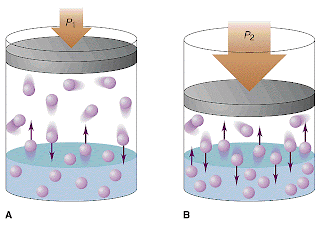


Today was a notes day. We explored how certain conditions, specifically temperature and pressure, impacted the solubility of solutions. Each of these conditions affects their solute differently based on its state of matter; a solid, gas, or liquid.
An increase in temperature for solids and liquids results in an increase of solubility, as the intensified intermolecular motion allows for a more thorough interaction between the solute and solvent. However, higher temperatures in gases results in molecules being released to the atmosphere instead of contained within the solvent, resulting in lower solubility.
Pressure only changes the solubility of gases. Solids and liquids already have their molecules tightly packed so that an increase in pressure would not change the structure of the solute enough to change solubility. Gases are more prone to be altered by pressure because their molecules are more spread out. The increase in pressure forces the molecules of gas down into the solvent, increasing solubility.
We discussed real world examples describing the relationship between pressure and solubility. Soda is kept under high pressure in its can. When that pressure is released when the can is opened, pressure no longer forces the CO2 molecules in to the soda. The CO2 rises to the top in the form of bubbles and thus, carbonation.
Here's some scientific photos to help explain:
BEFORE:
AFTER:
It seems as though a rapid decrease in solubility also has the side-effect of a spontaneous age, gender, and race change.
I guess the next scribe is Michelle T., to fill her duties from today.
Subscribe to:
Posts (Atom)