Today and yesterday in Lieb's class we started off by talking about the 3 worksheets we need print off of moodle after this we began
our class notes on the 5 types of reactions: Synthesis, Decomposition, Single Replacement, Double Replacement, and Combustion Reactions. A synthesis Reaction is when you are given two reactants that combine to give you one product for example: 2H2 + 02 -----------> 2H20
A Decomposition Reaction happens when compunds are broken into elements or similar compounds. Example: 2H20 ---------> 2H2 + 02
A Single Replacement Reaction is when an element replaces another compound. These only take place in wate. Example: NaCl + F2 ---------> NaF + Cl2
A Double Replacement Reaction happens when one metal replaces another in a compound and the same for the non-metals. Example: AgN03 + NaCl ----->AgCl + NaN03
A Combustion reacion only occurs when a hydrocarbon reacts with oxygen gas. Example: C5H12 + 802 ------>5CO2 + 6H20
Now on to the Classifying Chemical Reactions Lab YES!!!!!!!!!!!
So, to begin with we went over the Pre-Lab in Question 1 we had to summarize the chemical reaction of sodium bicarbonate, carbon dioxide, and water. This turned into
2NaHC03-----> C02 + H20 + Na2C03. When balanced.
We then had two days to go through the 7 different stations and do all the experiments. In reaction 1 We Burned Magnesium ribbon. The Magnesium ribbon lit on fire and got chalk white after it burned. The chemical Reaction that occured was 2Mg + 02 ----> 2Mg0.
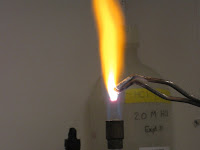
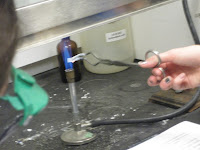
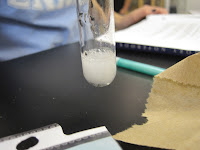
In the first picture we see the product of the Magnesium ribbon turning pure white and in the second it is lighting on fire.
In reaction 2 we put hydrochloric acid in a test tube with Magnesium Metal, and then we lit a wood splint and put it in the tube where it was extinguished. These turned into
2HCl+ Mg ----> MgCl2 + H2
The answer above has been balanced. In this picture we see the hydrochloric acid and Magnesium Metal Ribbon mixing and bubbles occuring.
In reaction 3 we put ammonium carbonate in the test tube an burned for 30 seconds then we put a piece of litmus paper at the top and an odor was released. This odor was amonia next we put a piece of wood flint on fire into the tube which was extinguished. The reaction for this was (NH4)2C03---> C02 + NH3 + H20 when balanced.
In this picture we see the mixture of amonia being released.
In reaction 4 we put calcium carbonate in a test tube with hydrochloric acid and once again lit a wood splint which was extinguished.
This reaction when balance became 2CaC03+ 2HCl-----> 3C02 + 2CaCl + H20.

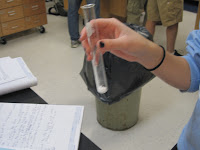
In the second picture we see the wood splint being extinguished.
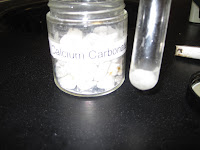
In the first picture we see the Calcium Carbonate and hydrochloric acid mixed.
In reaction 5 we mixed copper (II) Chloride and mossy zinc together and the mozzy zinc change color from silver to read. CuCl2 + Zn-------> ZnCl2 + Cu. When balanced.
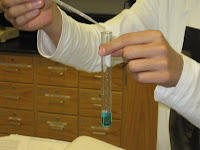
In this picture we see the zinc changing color.
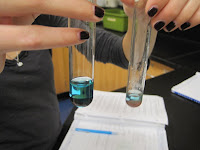
In reaction 6 we added copper chloride with sodium phosphate and a precipitate formed. When this reaction was balanced it became
3CuCl2 + 2Na3P04------> Cu3(PO4)2 + 6NaCl
In this photo you can see the precipitate forming.
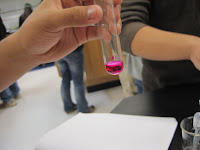
In reaction 7 we mixed sodium hydroxide and phenolphthalein and the hydrochloric acid. During this reaction it at first became pink and then back to clear liquid color whise. In this reaction when balanced it became NaOH + HCl-----> H20 + NaCl As you can see in the pictures below it demonstrates the pink on the right and then clear again on the left
Well that was our class in a nut-shell and the coveted spot of scribing for Thursday goes to my man Josh D CONGRATS!!!


 Today we had shortened classes and Mr. Liberman was not there. So, we had a sub and we got to watch Myth Busters! SWEAAAAAAAAAAAAT! This episode was the second one they have done on ninjas. They were retesting if a ninja could actually catch an arrow, but this time they had the most accomplished ninja in the world today who happened to be Australian. Adam and Jamie the two hosts talked about how that the speed of an arrow does not change on release from the bow to impact with its target. The first experiment was to see if the ninja could catch tennis balls going 80 mph's and he caught 22 in a row a Guiness World Record. Then Jamie tried to accomplish this feat thinking it was being overplayed he was soon pelted relentlessly with thennis balls quite amusing. Next, Carry, Grant, and Tory tested the old assination technic that ninjas would lay in wait in river banks breathing out their blow guns and then using them to kill their target. First they checked how long Tory could stay underwater with out suffering hypothermia and he felt he could last about an hour. Next they tested if they used an all natural blow gun how their aim would be. Tory and Grant made all natural ones but they accuracy was pitiful. Next, Carry who cheated by putting a metal rod in had perfect accuracy. Next she sat underwater and had to deal with the refraction of the water to hit the target. Eventually she go the hang of it. Next they tried to put all the aspects together breathing through it, being cold, and having to transfer the dart in. The myth was busted because no one could load the dart without shooting it with water. Back to Jamie and Adam they put their ninja to the test when he caught an arrow then they put him between three archers and at first he could not do it. Eventually when they moved back and the one who had to shoot had to draw his bow the ninja caught it. The next segment was supposed to be the one inch punch but we did not get to it. Thats it the next scrib is Matt Park